
Appearance
FossibleWorks Health Central
One Healthcare IT platform — enabling future-ready & scalable care delivery.
Most healthcare technology forces a trade-off. You buy a hospital management system (to manage CareOps) that runs operations but treats clinical data as an afterthought — or a clinical EHR that's standards-compliant but can't run a hospital. Then you spend years and budgets stitching them together, and your AI ambitions stall on top of data that never quite agrees with itself.
Health Central is one platform that does all three — and does them well.
Build your product. Not your plumbing.
The Foundation, at a Glance
Humans — One Identity, Three Front Doors
PractitionerPatientOperations
AI Agents — Inside the Perimeter
Internal Agents3rd-Party AgentsSMART on FHIR Apps
Open Standards · FHIR R4 · APIsAI Agent Access
One login · one permission model · one deployment ↓
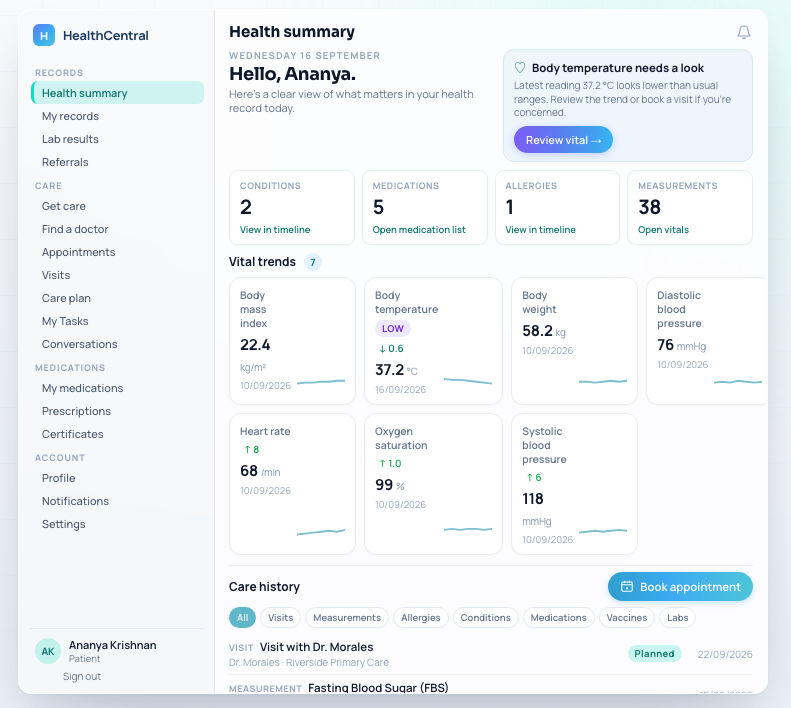
PractitionersClinical Provider WorkspaceCharting · orders · results · clinical workflows
PatientsPatient PortalRecords · appointments · results · messaging
OperationsOperations DeskBilling · front desk · inventory · finance
Clinical & operational data — always in sync, in real time ↓
ClinicalFHIR R4
Clinical Record
FHIR-native · standards-compliant
EncountersObservationsConditionsMedicationsDiagnostic ReportsCare Plans
Always
in sync
in sync
OperationsHIS · PMS
Operations & Finance
Enterprise-grade · healthcare-shaped
Registration · ADTScheduling · LIS / RISBilling & RCMInventory · ProcurementAccounting · HR / PayrollWorkflows
One Source of Truth
Real-time syncUnified audit trailRole-based accessABDM · HIPAA · NABH ready
Extend it — every extension inherits the same identity, permissions & audit ↓
SMART on FHIR
Plug in third-party clinical apps, securely scoped to exactly the data they're allowed to see.
Business Apps
CRM, HR, helpdesk, and custom workflows — add what you need, all under one roof.
Analytics
Purpose-built clinical data warehouse for population health, risk, outcomes, and AI.
FHIR-Native · AI-Ready · Always in Sync · Open Standards · No Vendor Lock-In
The Problem With Healthcare IT Today
- Two systems, one patient. Operations in one product, clinical data in another — and a permanent integration project keeping them barely in sync.

- Stale data everywhere. Nightly batch jobs and reconciliation queues mean the number on screen is often hours old. Nobody fully trusts it.
- AI that can't ship. Pilots impress in a demo, then die in production because the data is inconsistent, the permissions are unclear, and no agent can see the whole patient.
- Lock-in and license sprawl. Per-seat clinical licenses, per-module operational licenses, per-integration fees — and you still don't own your data.
Health Central is built to erase all four.
How It Compares
| HIMS-only system | Clinical EHR-only | DIY integration | Health Central | |
|---|---|---|---|---|
| Full hospital operations | ✅ | ❌ | ⚠️ partial | ✅ |
| FHIR-native clinical record | ❌ | ✅ | ⚠️ mapped later | ✅ |
| One login / one permission model | ✅ | ✅ | ❌ | ✅ |
| Real-time, no ETL between systems | n/a | n/a | ❌ | ✅ |
| Production-grade AI / MCP surface | ❌ | ⚠️ clinical only | ❌ | ✅ both planes |
| Open standards, you own the data | ⚠️ varies | ⚠️ varies | ⚠️ varies | ✅ |
One Platform, Three Surfaces
1. A Maximal Hospital Management Surface (HIMS)
Everything it takes to run a hospital or clinic group, built in — not bolted on:
- Patient registration, ADT, bed and ward management
- Appointment scheduling, queues, and front-desk workflows
- Billing, revenue cycle, and insurance
- Pharmacy, inventory, and procurement
- Accounting, HR, and payroll
This is enterprise-grade operational depth, purpose-shaped for healthcare. You're not buying a thin clinical app and improvising the business side — the entire operational backbone of a hospital is native to the platform. → Fossible HIS
2. FHIR-Native Clinical EHR / EMR
The clinical record is built on FHIR R4 from the ground up — not exported to a standard later, but standards-compliant the moment data is created. That means:
- Specialty- and department-specific clinical workflows — built directly on FHIR resources
- Lab (LIS), radiology (RIS), therapy, and the full encounter → order → result loop
- Terminology baked in: ICD-10, SNOMED-CT, LOINC, RxNorm, CPT/HCPCS
- Interoperability that's native, not a project: HL7 v2, CDA, SMART on FHIR, CDS Hooks, device integration
Your clinical data is portable, interoperable, and ready for ABDM / HIPAA / NABH-grade compliance by design — because it was FHIR-native from day one.
3. Every Box Checked for the AI Agent & Worker Surface
AI in healthcare fails on infrastructure, not models. Prototypes die in production because data access is inconsistent, permissions are unclear, and the integrations are fragile. Health Central is built so agents are safe enough to actually deploy:
- Full programmatic access — every clinical resource and every operational record is reachable through a stable API. No UI-only operations, no internal pathways agents can't reach.
- MCP-native on both sides — a clinical MCP surface and an operational MCP surface, so agents get discoverable, scoped, auditable tools out of the box.
- Standardized data models — clinical data is FHIR, which modern AI models already understand. No brittle, org-specific schemas to teach an agent.
- Real guardrails — agents operate inside the same permissions, workflows, and audit trail as humans. The "can suggest, but a person acts" pattern is enforced by the platform, not promised in a slide.
- The whole picture, at once — because operations and clinical data live in one platform, an agent can reason over both — billing and the encounter, the order and the inventory — inside one permission and audit perimeter. Single-domain platforms structurally can't do this.
This is the surface that powers documentation agents, RCM and prior-auth automation, care coordination, and agentic workers — on a real, auditable system of record.
Native FHIR, Working for You — Not Just a Checkbox
Being FHIR-native isn't a compliance badge — it's leverage. Because the clinical record speaks FHIR from creation, the whole standards ecosystem works out of the box, no mapping project required:
- Da Vinci CRD (Coverage Requirements Discovery) — surface payer coverage requirements, prior-auth needs, and documentation rules at the point of order, in the clinician's flow.
- CDS Hooks — real-time clinical decision support fires inside the workflow: order-select, order-sign, patient-view, and your own custom hooks.
- SMART on FHIR — plug best-of-breed clinical apps straight in, with scoped, consented access.
- Bulk FHIR & open APIs — move populations of data in and out cleanly for analytics, reporting, and exchange.
Standards that are usually a multi-year integration effort are simply available, because the foundation was FHIR-native from day one.
Built for Two Kinds of AI
Healthcare AI isn't one thing. Health Central is built for both.
AI agents that assist. Copilots that work alongside your clinicians and staff — drafting clinical notes, summarizing a patient's history, surfacing the right context at the right moment, recommending an order or a next step. The human stays in control of the final action.
AI workers that get work done. Autonomous workers that own end-to-end operational workflows:
- Revenue cycle — claims preparation and submission, prior authorization, denial management, payment posting, eligibility checks
- Patient operations — intake and registration, scheduling and rescheduling, reminders, follow-up
- Care coordination — routing results, flagging gaps, triggering the next step in a care plan
- Back office — inventory, procurement, reconciliation, reporting
These aren't chatbots bolted onto a dashboard. They're operators inside your system — working through the same permissions, the same workflows, and the same audit trail as your human staff. See how the AI layer works →
Why the Architecture Wins
Beyond the three surfaces, the platform's structure delivers benefits competitors can't easily copy:
One identity, single sign-on. Clinicians, patients, and operations staff authenticate once. Three role-based front doors — provider, patient portal, operations desk — one identity, one permission model, one deployment.
No ETL. Near real-time everywhere. There's no nightly batch job syncing a clinical mirror to an operational source of truth. Clinical and operational data are each read live from their owner. Reports, dashboards, and — critically — AI agents act on current state, not yesterday's snapshot.
Analytics, done right. Clinical and financial analytics run on a dedicated, healthcare-grade data warehouse — keeping heavy analytical load off your live systems while giving you insight across both clinical outcomes and revenue.
Open standards, no vendor lock-in. Built on FHIR R4, SMART on FHIR, and CDS Hooks. You own the data and the deployment — no proprietary clinical format holding your record hostage.
Enterprise-Grade, by Default
The foundation ships with the things that are normally a multi-year program in their own right — clinical standards, compliance posture, ERP depth, and a build layer to make it yours.
Clinical standards and terminologies, native. FHIR R4 as the system of record, plus the terminologies real clinical work runs on — ICD-10, SNOMED-CT, LOINC, RxNorm, CPT/HCPCS — and the interop standards to move data in and out: HL7 v2, CDA, SMART on FHIR, CDS Hooks, Da Vinci CRD, DICOM-ready imaging. Standards-compliant as data is created, not converted after the fact.
Enterprise compliance and HIPAA build-ready. The platform is built to be deployed into regulated environments — HIPAA build-ready, and architected for ABDM and NABH alignment. Role-based access control, a complete standards-based audit trail across both clinical and operational actions, encryption, consent and scoping for third-party apps, and flexible hosting — cloud, on-prem, hybrid, or air-gapped — so the data-residency and isolation requirements of your jurisdiction are a deployment choice, not a re-architecture.
Full ERP depth, not a thin billing module. You get a real enterprise backbone: billing and revenue cycle, inventory and procurement, accounting and finance, HR and payroll, CRM, helpdesk, and asset management — proven at scale, shaped for healthcare.
Low-code and no-code, built in. A low-code/no-code layer lets your team extend the platform without forking it — custom objects, fields, forms, workflows, dashboards, reports, permissions, and automations. Every new object you create is automatically API- and MCP-addressable, so it's agent-ready the moment it exists. Build what's specific to your model; inherit the rest.
Hydra for rapid implementation. Hydra AI doesn't just power runtime agents — it accelerates the build itself. Standards-native, open, agent-addressable data means AI tools already understand the platform, so configuration, specialization, and go-live happen in a fraction of the usual time. Tailor a specialty workflow, stand up a department, wire an integration — fast, because the foundation was designed for it. See how the AI layer works →
Who It's For
Multi-site hospitals and clinic groups that want clinical and operational workflows in one platform — not five integrated products held together with pipelines.
Diagnostic and imaging chains running high-volume LIS/RIS with device integration and FHIR-standard reporting.
Specialty and multi-specialty providers needing configurable, FHIR-native clinical workflows tailored per department. We tailor the clinical EMR/EHR for one or two specializations to start with, then expand as you grow.
AI-native healthcare companies building agents for documentation, RCM, prior auth, or care coordination — who need a real, auditable system of record across both clinical and operational domains underneath their models.
Organizations pursuing ABDM, HIPAA, or NABH compliance that want FHIR-native architecture and an audit trail spanning the whole action — not compliance retrofitted after the fact.
What You Get
- One source of truth, not two systems to reconcile. Operations and clinical care share an identity, a permission model, and a deployment.
- Faster time-to-value. Standard hospital and clinical workflows ship configured, not custom-built. Stand up departments and specialties without a multi-year integration program.
- Lower total cost of ownership. Open-standards core means no per-seat clinical license tax and no per-integration fees. You pay for managed deployment and support — not for the right to access your own data.
- Real-time decisions. Live data across operations and clinical care means dashboards, billing, and agents act on what's true now.
- A platform that grows with you. Add operational apps or SMART on FHIR clinical apps without re-architecting. New capability is more of the same store, under the same rules.
Security, Privacy & Compliance — By Design
- FHIR-native architecture maps directly to ABDM, HIPAA, and NABH expectations — compliance is structural, not retrofitted.
- One audit perimeter. Every action — human or agent, clinical or operational — flows through the same role-based access control and audit trail. Reconstruct any action end-to-end from a single trail.
- Scoped, consented access for third-party apps. External clinical apps get FHIR-only, scope-limited tokens — no path to your operational or financial data.
- Agents inside the perimeter, not behind a backdoor. AI operates under the same permissions and audit as a clinician or clerk. No parallel, unaudited automation path.
Why Now
The healthcare AI moment is real — but it rewards organizations with clean, complete, real-time data and a system of record agents can safely act on. Most can't deliver that because their data is split across stale, integrated silos. Health Central is built specifically for this moment: the operational and clinical foundation that makes agentic healthcare deployable, not just demo-able. Build the foundation now and the AI roadmap compounds on top of it.
Frequently Asked
Is this a single product or two stitched together? One platform — one identity, one UI shell, one deployment. The clinical and operational planes are distinct by design, but unified everywhere it matters to a user, operator, or auditor.
Do we get locked in? No. The platform is built on open standards — FHIR R4, SMART on FHIR, CDS Hooks. You own the data and the deployment.
Where does our data live? Wherever you deploy. Managed via Espresso Cloud, or run it yourself — cloud, on-prem, hybrid, or air-gapped. Your choice, your infrastructure.
Can our existing AI / SMART on FHIR apps plug in? Yes. The clinical plane is a standards-compliant FHIR server; the operational plane is fully REST- and MCP-addressable. Both plug in without bespoke integration.
How do we handle analytics? A dedicated clinical + financial data warehouse runs healthcare-grade analytics without loading your live systems.
Explore the Platform
- Fossible HIS → — the hospital and practice-management backbone
- Hydra AI → — the AI agent and worker layer that operates across both clinical and operational planes
- Technical deep-dive → — the full architecture, open-source stack, and standards detail
Build on the Foundation
Book a Demo → · Explore the Platform →
Health Central is deployed and managed through Espresso Cloud, our enterprise managed-infrastructure platform — so your team focuses on building, and we handle the DevOps, scaling, and SLAs.
FossibleWorks Health Central is built and maintained by Fossible Works Inc. (NY, USA) and Tacten Services LLP (Bangalore, India).